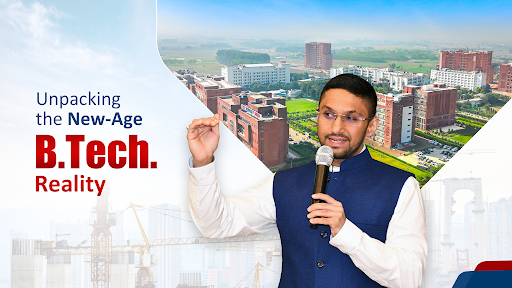
Unpacking the New-Age B.Tech. Reality
The B.Tech. discipline, as a whole, has traditionally commanded a substantial amount of prestige, and rightly so. After all, there are a few other domains that can claim to have delivered as many career prospects, or as rewarding, as the global engineering ecosystem. However, despite such a glowing track record, the field currently stands at a crossroads because of our evolving tech reality and subsequent adjustments in the talent template which is required by employers. This shift, in fact, is already forcing a rethink, predominantly bringing into focus the declining effectiveness of theory-centric learning. With the space of technology getting more and more layered each day, it has become imperative for the world to educate engineering aspirants in a different manner, and from a collective standpoint, the answer to this conundrum is emerging in the form of a practical and more hands-on learning experience. You see, rather than taking students through knee-deep theory work, the modern institutions are now looking to provide an environment poised for experimentation, thus empowering every individual to learn by actually doing.
Having referred to the overarching transition, we now must take a deeper view of what all it is bringing in its wake, beginning from the potential for greater career avenues. Gone are the days when a large part of students would remain restricted to pursuing a degree in Civil, Mechanical, or Electrical Engineering, as today, one can hope to go for an engineering degree in various new-age concepts, such as Artificial Intelligence, Data Science, Machine Learning, Robotics, Cloud Computing, Cybersecurity, and more. Further sweetening the proposition is an opportunity to combine some of these components into a single course workflow.
This shift, on its part, also guides us to our next by-product of the evolved engineering landscape i.e. technology’s integration on a curriculum level. By helping students understand the nuances of these technologies early in their journey, institutions can really nurture them to stay ready to thrive in a new-look professional premise. Specifically speaking, studying something like data science can enable individuals to use algorithms, analyze big data, and even create intelligent systems for far-reaching use cases spanning computer science, manufacturing, healthcare, supply chain management, GovTech, and more. Beyond that, pursuing education with a strict consideration for robotics can allow you to build a coming-of-age robotics system, capable of enhancing the picture in both personal and professional settings.
On top of that, as the intention is to deliver this tech exposure under a practical arrangement, it also goes the distance to foster an innovative instinct among students, and, therefore, ultimately achieve a better tomorrow for the wider world.
Again, using this as a segue into another part of today’s engineering sector, we now widen the view on changing research dynamics. The research framework has officially moved out of your conventional testing touchpoints. Instead, it is now rooted in bleeding-edge simulation labs, automated workshop centers, and specialized skill development zones that all work in complete synergy to ensure actionable and holistic education.
Then, there is the clear pledge to impart education in close collaboration with leading corporate houses. Paving the way for a unique perspective, education-centered organizations are now establishing strategic tie-ups with technology leaders across the board to help students acquire an unprecedented insight into industry best practices, challenges, as well as distinctive ideas that are being leveraged against those bottlenecks. Aspirants are also bestowed with career-focused internships, well-equipped to enhance their learning through a closer look at the ground reality.
Apart from partnerships with business enterprises, the modern engineering archetype benefits from link-ups with other educational institutions that unlock a host of new networking opportunities.
We alluded to the advent of an unparalleled engineering reality, but what we haven’t mentioned yet relates to how few programs, in particular, are presently leading this transformation.
These programs, to begin with, include a B.Tech. spin revolving around the idea of GenAI. If we assess stats for a second, the global GenAI market is projected to breach a whopping $1 trillion by the year 2032. Such an enormous upside means students can expect to extract, moving forward, significant value from subjects like deep learning, natural language processing, robotics, and data-driven modelling. In fact, at CGC University, Mohali, we combine this on-paper potential with an industry-oriented curriculum, backed by real-world expertise in analytics, artificial intelligence, and cloud computing. The result is a career avenue brimming with potential roles like Prompt Engineer, Machine Learning Engineer, AI Product Manager, Gen AI developer, Natural language processing (NLP) Engineer, and AI UX Designer, etc.
The next program rewriting that narrative for engineering is B.Tech. (Quantum Computing). In case you weren’t aware, quantum computing hails from granular aspects like Quantum Computing Foundations, Machine Learning with Quantum Computing, Quantum Computing for Data Analysis, Quantum Cryptography, Quantum Information Theory, Quantum Computer Architecture, Security and Privacy for Big Data Analytics, as well as Cloud Infrastructure and Services. Students enrolled in the B.Tech. (Quantum Computing) program at CGC University, Mohali, can further enjoy industry-leading resources, available with expert-level guidance.
Anyway, once they establish a professional-grade hold on the given subjects, aspirants will be able to reach for various rewarding roles, spanning Quantum Research Scientist, Quantum Applied Scientist, Quantum Device Engineer, Quantum Process Design Engineer, Equipment and Integration Engineer, and more.
Then comes the purview of Fintech. Valued, as of 2025, at more than $320 billion, the fintech market is responsible for ideas like Digital Banking Systems, Blockchain Technologies, Algorithmic Trading, AI-based Financial Modeling, Fraud Detection Systems, and Risk Analytics. At CGC University, Mohali, this vast focus coexists with a robust Entrepreneurship Hub, Industry Visits, extensive Academic Resources, as well KPMG-backed insights to facilitate a top-notch brand of education. Here, the career prospects for students can range from Financial Analyst, Fintech Product Manager to Crypto Investment Director, Risk Manager, Compliance Manager, Wealth Manager, and more.
Moving on to B.Tech. (Cyber Security), it taps into newly-refined counter-measures for the growing frequency of cyberattacks. A full-fledged degree, committed to this area, can help you better understand details associated with Data Security, Application Security, Risk Management, Governance, Cloud Security, Compliance, and Zero-trust Security. This knowledge should eventually propel students to pursue roles like Cybersecurity Analyst, Security Software Developer, Information Security Engineer, Ethical Hacker, Cybersecurity Manager, Network Engineer, and Incident Responder, etc. To make the proposition even more attractive, CGC University, Mohali, orchestrates access to dedicated cybersecurity hubs and wider computer labs, geared towards preparing students to tackle the severe demands of today.
Hold on, we still haven’t delved into B. Tech. (Artificial Intelligence and Machine Learning). A typical engineering degree in AI and M can be tipped to traverse analytical, technological, and critical-thinking skills necessary for succeeding in today’s highly-competitive environment, while simultaneously taking into account real-world datasets, case studies, and industry-certified modules that actively integrate theory with practical nuance.
At CGC University, Mohali, we have recognized the paradigm shift in engineering and the same is fully reflected in our revamped curriculum, which covers a host of advanced technologies. For better understanding, under our newly-introduced School of Newton, we offer students a look at best-in-class solutions, with its programs including:
- B.Tech. Computer Science and Engineering (FinTech & Artificial Intelligence) in Collaboration with KPMG
- B.Tech. Computer Science and Engineering (Artificial Intelligence and Machine Learning) in Collaboration with Ernst & Young (EY)
- B.Tech. Computer Science and Engineering (GenAI) In Collaboration with IBM
- B.Tech. Computer Science and Engineering (Quantum Computing) in Collaboration with IBM
- B.Tech. CSE (with Minors in Open-Source Programming)
- B.Tech. Electronics and Communication Engineering (with Minors in Data Science and Artificial Intelligence)